Digitone II Mods / waverider
Waverider
Waverider is a sixth synth machine for the Digitone II. Waverider has two wavetable oscillators, a sub-oscillator, noise, FM, wave folding, phase warping and a collection of additional shapers like AM, ring modulation and formant. The tables are on the +Drive. Beta, OS 1.11.
Recorded from the Digitone II over USB audio, with no processing. Waverider plays the drone alone at the start and at the end. The other sounds are the Digitone II's stock machines.
This tab builds Waverider v0.5.2 (beta 1). See what changed.
Make sure that you can go back to stock before you flash a modified file. The Early Start-up Menu flashes the stock firmware over MIDI. Do this one time with the stock file before you flash a modified file. Back up your +Drive with DNX.
Go to 1.11 from 1.10E. If your unit has OS 1.10D, install the stock OS 1.10E first. Then install OS 1.11, stock or modified. Do not go from 1.10D directly to 1.11.
Your firmware
Use Elektron's Digitone II OS 1.11 .syx file. To combine mods, you
can also use a file from a different page on this site (refer to "Combines with" below).
Or drag the file here.
Get DNX
DNX runs in your browser. Use DNX to back up the +Drive and to put wavetables from WAV files on it. DNX also controls the pool of each project. When you go back to stock, DNX erases the Waverider data.
Install the file on the unit
- Back up the +Drive with DNX.
- Open Elektron Transfer.
- Connect the Digitone II to the computer with a USB cable.
- Drag the patched file onto the Digitone II in Transfer. The unit updates and starts again.
- Make sure that MACHINE SEL shows WAVERIDER after SWARMER.
No other steps are necessary. At first, the +Drive has no wavetables. When you add the first table with DNX, the unit prepares the storage.
Before you start
- Use Digitone II OS 1.11 only.
- First, use Waverider alone, on a new project. If a problem occurs, we then know that the cause is Waverider and not a combination of mods.
- When you report a problem, tell us which mods are in your file.
- If the unit does not start:
- Push and hold FUNC when you turn on the power.
- Open the Early Start-up Menu.
- Do an OS upgrade with the stock 1.11 file over MIDI DIN.
Combines with
You can combine Waverider with the other mods. You can combine Waverider with the FM drum transients, the LFO modulation of the FX and the fourth LFO in either order. We examined the combinations in the emulator, not on an instrument.
The table below is the Waverider row of the compatibility table. ✓: you can combine the two mods in either order. ✓*: you can combine them in one order only. ✗: you cannot combine them. To see the reason, put the pointer on a cell.
arpmodes | arpplocks | arpscale | bootscreen | degreetranspose | directjump | fxmod | layermidi | lfo4 | lfolength | lfowaves | midiarp | moddest | reloadconfirm | sendloop | songguard | transients | usbprobe | waverider | |
|---|---|---|---|---|---|---|---|---|---|---|---|---|---|---|---|---|---|---|---|
Waverider, a sixth machine waverider | ✓ | ✓ | ✓ | ✓ | ✓ | ✓ | ✓ | ✓ | ✓ | ✓ | ✓ | ✓ | ✓ | ✓ | ✓ | ✓ | ✓ | ✓ | — |
Version and changes
The version of Waverider is v0.5.2 (beta 1). The list shows the changes in each version, with the newest first. A link in the list opens the part of this page about the change.
- v0.5.2
- After you change the pattern, page 1 no longer shows modulation from the previous pattern's sound. Before, POS could move on the screen with no LFO and no MOVE in the sound, until you played a note. The sound was not affected.
- v0.5.1
- The WAVETABLE page of PRESET/KIT no longer goes back to the presets when you press a key just as the unit's internal tick counter starts again. This happened about every 30 seconds.
- The WAVETABLE MANAGER list shows the +Drive slot of each table, 000 to 255, at the left.
- The table lists show up to 22 characters of a table's name. Before, they showed 15.
- v0.5.0
- Beta 1. Waverider is now a beta. The sound is the same as in 0.4.2.
- Tables load from the +Drive about four times as fast.
- The WAVETABLE page of PRESET/KIT stays open when you press DOWN quickly in a long list. Before, it could go back to the presets.
- v0.4.2
- Fixes one part of the DSP data in 0.4.1 that had a length the DSP may not load at start-up. Waverider sounds the same.
- v0.4.1
- TBL item -, an empty pool slot and a table that is still loading stay silent while a note plays. In 0.4.0 they could play another table after a moment.
- v0.4.0
- Waverider has no built-in tables. Every table comes from the pool. DNX can install Prim. and Harm. on the +Drive, as it adds any table.
- TBL's first item is -, no table: it plays silence, and the page draws no wave. Pool tables start at T:001. A new Waverider sound starts with TBL1 and TBL2 on -.
- An empty pool slot, a table that is not on the +Drive, and a table that is still loading play silence. Before, they played Prim.
- A sound saved with an older Waverider plays another table. Set TBL1 and TBL2 again, or let DNX move the old TBL values for you.
- v0.3.9
- Page 1 of a track you just made a Waverider in MACHINE SEL no longer shows the old machine's modulation on POS. A voice shows its modulation from its first note on.
- Changes inside the mod leave room on the DSP for later features. The sound stays the same.
- v0.3.8
- Knob D on page 5 is now FSRC, the FM source: OSC2, SUB or NOIS. OSC2 is FM as before. SUB and NOIS let the sub-oscillator or the noise of page 3 change osc 1.
- FM alone sets how much the source changes osc 1. SUB and NOIS on page 3 set only how loud you hear the sub and the noise.
- With FSRC at SUB, the sub follows osc 1, and SRC has no effect.
- The sub's SQR and PLS waves add fewer harsh tones on high notes. SIN and TRI sound as before.
- v0.3.7
- Waverider uses less of the DSP. With a 16-note chord, the load is about 5 points lower with page 5 off and about 9 points lower with all of page 5 on. The sound stays the same.
- v0.3.6
- FM on page 5 and LEV2 on page 2 are now separate. FM alone sets how much osc 2 changes osc 1, and LEV2 sets only how loud osc 2 is. With LEV2 at 0 you hear osc 1 alone, changed by FM.
- A sound saved with FM above 0 and LEV2 below 100 now has more FM. Set FM again on it.
- v0.3.5
- WARP and FM on page 5 get softer on high notes, so they add fewer harsh tones there. At 127, WARP starts to get softer at about D#4 and FM at about G#4. Lower notes sound as before.
- v0.3.4
- The noise on page 3 now plays on voice 16 too. Before, it faded out right after each note started when the sound played on voice 16.
- v0.3.3
- v0.3.2
- Every knob on Waverider's five pages now answers MIDI CC and NRPN. Pages 1 to 4 use the numbers each knob place has on the other machines: CC 40 to 77 and NRPN 1:73 to 1:104. Page 5 uses CC 12, 15, 35, 36, 37, 83, 93 and 119, and NRPN 1:112 to 1:119.
- TYPE on page 5 has a fourth value, Formant: AMT picks the vowel, P1 moves the formants up and P2 sets the dry part.
- When you turn a Waverider knob with MIDI out on, the knob sends the same number.
- A CC or NRPN sent to a track that is not on the screen now keeps that track's own limits.
- v0.3.1
- SLW1 and SLW2 on page 4 now turn the other way: Off is at the far left, and the slew gets longer to the right. A new sound starts with the slew off. A sound saved with an earlier version plays its SLW the other way round, so set SLW1 and SLW2 again on it.
- v0.3.0
- Alpha 5. WARP bends the phase of the two oscillators, and FM lets osc 2 change the phase of osc 1. NPOS, P1 and P2 do not change the sound yet.
- A sound with WARP and FM at 0 sounds as before.
- v0.2.0
- Page 5 plays: FOLD folds the oscillators' wave, and TYPE Ring or AM mixes osc 1 with osc 2 by AMT. WARP, FM, NPOS, P1 and P2 do not change the sound yet.
- TYPE offers Off, Ring and AM. A sound with page 5 at 0 sounds as before.
- v0.1.3
- You can now combine Waverider with LFO modulation of the FX and with the fourth LFO, in either order.
- v0.1.2
- Alpha 3. A turn of TRIM no longer clicks while a sound plays. The level now moves to the knob's value over up to 0.1 s.
- v0.1.1
- Alpha 2. On page 4, SMT1 and SMT2 are now SLW1 and SLW2 (slew). The header shows Osc1 POS Slew and Osc2 POS Slew. The slew operates as before, and saved sounds keep their values.
- The page has a Technical tab: the table formats, the files that DNX accepts, how the reader plays a table, DCLK, SLW and SYN, and the noise.
- v0.1.0
- The first public build (alpha). Waverider 0.1.0 has two wavetable oscillators with MOVE, a sub-oscillator, noise, sound options and wavetable pools from the +Drive. Page 5 is for a future version.
Documentation version 1.11, 2026-11-08. It describes Waverider v0.5.2 (beta 1).
Select Waverider
WAVERIDER is in MACHINE SEL, after SWARMER. A Waverider track has five SYN pages. The header shows Waverider (1/5) to Waverider (5/5).
Pages 1 and 2: the oscillators
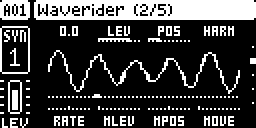
Page 1 is for oscillator 1. Page 2 is for oscillator 2. The two pages have the same controls.
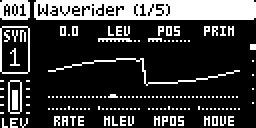
| Knob | Control | Function |
|---|---|---|
| A | TUNE / DETN | The pitch in semitones. TUNE changes the pitch of the two oscillators. DETN is the difference from oscillator 1 |
| B | LEV | The level, 0 to 127. At 100, the gain is 1 |
| C | POS | The position in the table, 0 to 120 |
| D | TBL | The table: "-" (no table, silence), then the pool tables from T:001 |
| E | RATE | The speed of MOVE, 0 to 100. When SYN1 or SYN2 is on, RATE shows a note length |
| F | MLEV | How much MOVE decreases the level, 0 to 127. At 0, MOVE does not change the level |
| G | MPOS | How much MOVE changes the position, 0 to 100. At 50, MOVE does not change the position |
| H | MOVE | The shape that MOVE follows. There are eleven shapes |
The wave shows only one voice. Usually, this is the voice of the newest note. If not, it is the first voice that the page selected. The unit calculates all the voices, and you hear all of them. One cursor for each note is in "Plans".
There are eleven MOVE shapes. These five shapes stop at their end: Ramp Up, Ramp Down, Exp Up, Exp Down and Tri Once. These six shapes repeat: Up Loop, Down Loop, Tri Loop, Square, Rnd Hold and Rnd Glide.
Page 3: sub and noise
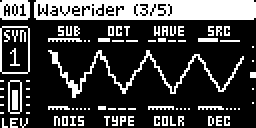
| Knob | Control | Function |
|---|---|---|
| A | SUB | The level of the sub-oscillator, 0 to 127. At 0, the sub-oscillator is off |
| B | OCT | -1, -2 or -3 octaves below the oscillator that it follows |
| C | WAVE | The wave: SIN, TRI, SQR or PLS (a 25 % pulse). SQR and PLS add few harsh tones on high notes (how) |
| D | SRC | The oscillator that the sub-oscillator follows: OSC1 or OSC2. With FSRC at SUB on page 5, the sub follows osc 1, and SRC has no effect |
| E | NOIS | The level of the noise, 0 to 127. At 0, the noise is off |
| F | TYPE | The noise type: WHT, PNK, BRN or DIG |
| G | COLR | The tilt of the spectrum, -64 to +63. A negative value adds low frequencies. A positive value removes them |
| H | DEC | The decay of the noise after each note, 0 to 126 (5 ms to 10 s). At Inf, the noise stays at full level |
The middle of the page shows the sub-oscillator and the noise.
Page 4: sound options
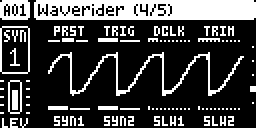
| Knob | Control | Function |
|---|---|---|
| A | PRST | The phase at the start of a note: Off, On or Random. With On, the phase starts at 0 and the same note has the same sound each time |
| B | TRIG | With Retrig, MOVE starts again on each note. With Free, MOVE does not start again on a note |
| C | DCLK | A crossfade when TBL, POS or the level changes suddenly: Off, or 1 to 100 ms. A new sound starts at 3 ms |
| D | TRIM | The level of the two oscillators, the sub-oscillator and the noise, -15.0 to 0.0 dB. The default, -11.0 dB, gives the same level as a default WaveTone. TRIM sets the level before FOLD and the shaper on page 5. Thus TRIM also changes how much FOLD folds, the balance that AMT sets for Ring, and the depth of AM. TRIM does not change the FM depth. When you turn TRIM, the level moves to the new value over up to 0.1 s |
| E | SYN1 | Off or On. With On, the MOVE of oscillator 1 follows the tempo. SYN does not change the LFOs, which have their own tempo settings |
| F | SYN2 | The same as SYN1, for oscillator 2 |
| G | SLW1 | Slew: the slew time of POS on oscillator 1. It slews the POS that you hear: the knob, p-locks, LFOs and MOVE together. A new note starts at its POS without a slew. At 0, the slew is off. The slew gets longer as you turn the knob to the right, up to 1 s at 127. The Technical tab has the details |
| H | SLW2 | The same as SLW1, for oscillator 2. Before version 0.1.1, SLW1 and SLW2 were called SMT1 and SMT2. Before version 0.3.1, Off was at 127. A sound saved with an earlier version plays its SLW value the other way round, so set SLW1 and SLW2 again on it |
The middle of the page shows the sound of the track as a scope.
Page 5: Shape
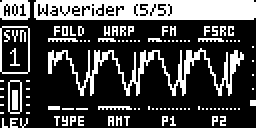
FOLD, WARP, FM, FSRC, TYPE, AMT, P1 and P2 change the sound. The middle of the page shows the scope, as on page 4.
| Knob | Control | Function |
|---|---|---|
| A | FOLD | Folds the wave of the two oscillators back on itself. 0 is off. A higher value gives more folds and a brighter sound |
| B | WARP | Bends the phase of the two oscillators. The first half of each wave plays in a shorter part of the cycle, and the second half in a longer part. 0 is off. A higher value gives a brighter sound |
| C | FM | The FM source changes the phase of osc 1 (frequency modulation). 0 is off. A higher value gives more overtones and a brighter sound |
| D | FSRC | The FM source: OSC2, SUB or NOIS. OSC2 is osc 2. SUB is the sub-oscillator of page 3, with its OCT and WAVE. NOIS is the noise of page 3, with its TYPE, COLR and DEC |
| E | TYPE | The shaper: Off, Ring, AM or Formant. Ring multiplies the two oscillators. AM uses osc 2 to change the level of osc 1. Formant filters the mix of the two oscillators so that it sounds like a voice that sings a vowel |
| F | AMT | With Ring and AM: how much of the shaper you hear, 0 is none and 127 is the shaper only. With Formant: the vowel, from A at 0 through E, I and O to U at 127 |
| G | P1 | With Formant: moves all the formants up, from no shift at 0 to one octave at 127. No effect with the other types |
| H | P2 | With Formant: the dry part. At 0 you hear only the filtered sound, and at 127 only the dry sound. No effect with the other types |
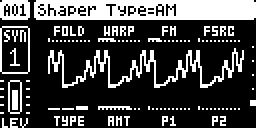
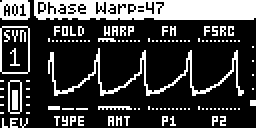
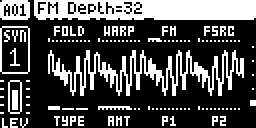
- Ring and AM need osc 2. On page 2, set LEV2 above 0. With osc 2 off, Ring makes the sound quieter and AM halves it.
- AMT starts at 64 on a new sound. With TYPE at Off, AMT changes nothing.
- Formant filters the oscillators only. The sub-oscillator and the noise are added after the filter. Only AMT can take an LFO, so an LFO on AMT sweeps the vowels.
- FOLD follows the level. A higher LEV1, LEV2 or TRIM gives more folds.
- FM and LEV2 are separate. FM sets how much osc 2 changes osc 1. LEV2 on page 2 sets only how loud osc 2 is. With LEV2 at 0 you hear osc 1 alone, changed by FM.
- FSRC SUB and NOIS work the same way. FM sets how much the sub or the noise changes osc 1. SUB and NOIS on page 3 set only how loud you hear them. At SUB or NOIS 0 you do not hear the sub or the noise, but FM still uses it.
- With FSRC at SUB, the sub follows osc 1. SRC on page 3 then has no effect.
- NOIS changes osc 1 a lot, even at a low FM. Try FM below 10 first. With a short DEC, the noise changes osc 1 only at the start of each note.
- FM and DETN: the interval between the two oscillators sets the overtones. DETN at 0, +12, +19 or +24 semitones gives a harmonic sound. Most other values give a metallic sound.
- WARP and FM change where the oscillator reads its wave. They do not change POS or the table.
- WARP and FM get softer on high notes. There they would add harsh tones that do not belong to the note. The higher the value, the lower the note where this starts. At 127, WARP starts to get softer at about D#4 and is off from about D#7. FM starts at about G#4 and is off from about G#7.
The Technical tab shows what each control does to the wave.
The wavetable pool
- Tables: each table has 1 to 64 frames. Each frame has 64 to 4096 points, in powers of two. Waverider plays the tables in the project's pool. DNX can install Prim. and Harm., the two tables that earlier versions had built in.
- Names: when you turn TBL, the header shows the table name, for example "T:004 name".
- Add and remove tables: use DNX, or use the wavetable page on the unit. To open the wavetable page, push PRESET/KIT two times. Each project has its own pool of up to 128 tables.
- Your project file is a normal project: the pool is on the +Drive, next to the project and not in it. Because of this, the stock firmware can load a project that you saved. Its Waverider tracks show as FM Tone, and the stock firmware reads their settings as FM Tone settings. Thus they have a different sound. We examined this in the emulator only, not on an instrument.
- An empty pool: a project with no pool has no pool tables. Its Waverider oscillators are silent until you add tables. A new project (CREATE NEW) has an empty pool. A project that you saved before you installed Waverider also has an empty pool.
- A deleted table: its pool slot shows MISSING and is silent. The slot stays until you clear it with CLEAR SLOT. Because the slot stays, a sound that uses the slot does not change to a different table.
- When you replace a table that plays: the old table continues to play until the new table is ready. Then the old table crossfades into the new table, in the DCLK time. If the first table of a slot is not ready, the slot is silent until the table is ready.
The wavetable page
Push PRESET/KIT two times. The left column has three lists: LOAD, MANAGE and POOL. The right column shows the pool of this project. IN POOL is the number of tables in the pool. FREE is the number of empty slots. +DRIVE is the number of tables on the +Drive.
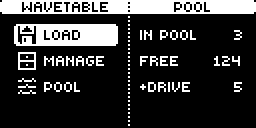
- Move: push UP or DOWN, or turn LEVEL/DATA. Hold FUNC and push UP or DOWN to move 7 rows.
- Open and close: push YES to open a list. Push NO to go back. Push PRESET/KIT or NO on the wavetable page to close it.
- Operations: in a list, push RIGHT. Push UP or DOWN to select an operation, then push YES. An operation applies to the ticked rows. If no row is ticked, it applies to the highlighted row. Push NO or LEFT to close the operations.
- LOAD: the slots of the pool. Select a slot and push YES. If the last SYN page that you saw is page 2, the table goes to TBL2. If not, it goes to TBL1. RIGHT shows LOAD TO TBL1 and LOAD TO TBL2. On a track that is not a Waverider track, LOAD changes nothing.
- MANAGE: all the tables on the +Drive. A + shows a table that is in the pool. Push YES to tick a table. ADD TO POOL puts the ticked tables in empty slots. DELETE removes the ticked tables from the +Drive, after you confirm with YES.
- POOL: the slots of the pool. CLEAR SLOT empties the ticked slots. A MISSING slot stays until you clear it.
- Empty slots show a line of slashes.
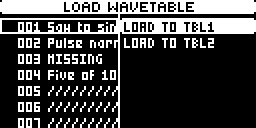
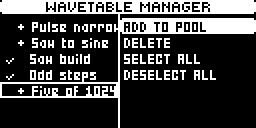
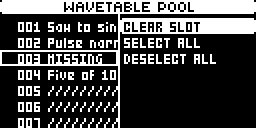
P-locks, LFOs and SAVE
- P-locks: you can p-lock all the controls on pages 1 to 5. The p-locks stay after a reboot, and after SAVE and LOAD.
- LFO destinations: all the controls except TYPE, P1 and P2 on page 5 are in the DEST list of the LFO. The controls are in two groups. Each group has the header SYN.
- MIDI: all the controls on pages 1 to 5 take a CC and an NRPN. The Technical tab lists the numbers.
Modulation on the page
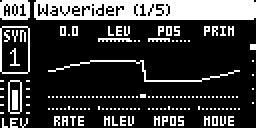
When an LFO or MOVE changes POS or TBL, the page shows the value that you hear next to the value that you set. Only POS and TBL show this, on the two oscillators. All other controls show only the value that you set. When a control does not move, the page shows nothing more. The page removes the range about two seconds after the movement stops.
- Slow, less than 3 Hz: a dot under POS shows the value that you hear. A dotted line shows the range of the sweep. A dotted cursor is under the position bar. The wave is the frame that you hear.
- Medium, 3 to 12 Hz: the dot is on a grey band. The wave shows the two frames at the ends of the sweep.
- Fast, more than 12 Hz: the page shows the band and the two frames, but no dot. The symbol ≈ is next to POS.
- TBL: the wave shows the table that you hear. The label shows the table that you set.
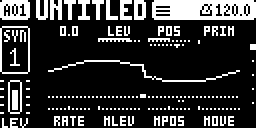
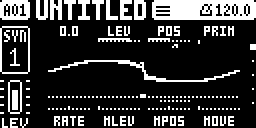
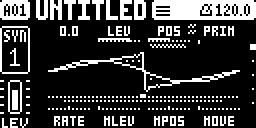
The reason for 3 Hz and 12 Hz: the page updates the screen up to 24 times a second. Up to 3 Hz (1/8 of that rate), the dot moves smoothly. Up to 12 Hz (1/2 of that rate), the dot moves in steps. Above 12 Hz, a dot that moves would show an incorrect, slower movement. For this reason, above 12 Hz the page shows only the range.
We made these captures in the emulator. The emulator does not run LFOs. For this reason, we wrote the value that you hear into the capture by hand. The emulator makes no sound. For this reason, the scopes on pages 4 and 5 show Waverider output that we rendered outside the instrument.
Go back to the stock firmware
Before you start, check these three conditions in DNX:
- You use Chrome or Edge. DNX needs one of them to save files into a folder.
- A DNX folder is set. To set it, click settings in the tool row, then DNX folder, then Choose…. DNX saves one file for each table there. Without a folder, DNX does not start the erase.
- WRITE is on, in the tool row at the top.
- In DNX, click settings in the tool row. Back up and Erase work from every tool except the probe.
- Under Back up the +Drive, click Back up…. This backup holds your projects, sounds and kits. It does not hold the wavetables.
- Under Erase the wavetable region, click Erase….
- DNX asks “Save a copy of N wavetable(s) first?”. Click Save the copies. On an empty store, the button reads Carry on.
- Wait while DNX saves each table as a file in the DNX folder. On a full store, this takes minutes. These files are the backup of your wavetables.
- DNX shows the counts and the names of what it will erase. Click Erase the region. DNX erases all the stored tables and all the pools, then reads the instrument again.
- Flash the stock 1.11 file.
Do steps 1 to 6 before step 7. The stock firmware 1.11 cannot get access to the wavetable region. If you flash the stock firmware first, the data stays on the +Drive. To remove it, flash Waverider again, do steps 1 to 6, and then flash the stock firmware again.
The erase does not change your projects, presets, kits and samples. A project that you saved with Waverider tracks stays on the unit.
To put a saved table back later, with Waverider on the unit:
- In DNX, open the library.
- In the list next to Browse, select Wavetables.
- Drag the saved file onto a free slot in the +Drive wavetables list. This only stages the table. DNX does not send it yet.
- Make sure that WRITE is on.
- Click Write staged tables.
Known limits in this beta
- A click may occur if the pool loads again while a note plays on a pool table. If you hear a click, tell us.
- We did not measure 4096-point tables on the unit.
- In a sound from a build before page 5, FOLD, WARP and FM show 64, and FSRC shows NOIS. Set FOLD, WARP and FM to 0 to get the sound from before.
Tests
Each row is one test. The row shows the test, where it ran and the result. "Instrument" is the Digitone II of the maintainer, with OS 1.11.
| What | Where | Result | Date |
|---|---|---|---|
| Page 5 knob D shows FSRC with OSC2, SUB and NOIS. With SUB or NOIS, FM changes osc 1 by ear. FM 0 sounds the same as OSC2 | instrument | passed | 2026-10-29 |
| The sub's SQR and PLS alone, notes 36 to 96: the power between the harmonics (Technical) | instrument | SQR -38 to -52 dB, PLS -36 to -47 dB. Without the polyBLEP, the model gives -17 to -31 dB | 2026-10-29 |
| The DSP code for FSRC, each block compared with the model, with SUB and NOIS on all 16 voices | emulator (SHARC) | 40 of 40 cases are the same, bit for bit | 2026-10-26 |
| The DSP code for the sub with the polyBLEP, each block compared with the model | emulator (SHARC) | 10 of 10 cases are the same, bit for bit | 2026-10-26 |
| A project with no pool shows an empty pool. A table that you add stays after SAVE and LOAD. CREATE NEW has an empty pool | instrument | passed | 2026-10-14 |
| On the file from this page: DNX stores a table, deletes a table and changes the pool of the working project | instrument | passed | 2026-10-14 |
| DNX erases the wavetable region: the unit shows no tables and an empty pool. A saved table that DNX writes back plays | instrument | passed | 2026-10-14 |
| The page builds the same file as the command line. The file starts from reset with no fault | browser and emulator | the same file. 21 of 21 integrity checks pass | 2026-10-14 |
| Stock 1.11 loads a project saved with a Waverider track | emulator | the project loads with no fault. The track shows as FM Tone | 2026-10-14 |
| One second of output from the DSP code (48,000 samples), each block compared with the model | emulator (SHARC) | 0 samples are different | 2026-10-14 |
| The erase removes the tables and the pools, and refuses incorrect requests | emulator | 11 of 11 checks pass | 2026-10-13 |
| The LFO DEST list: the order and the labels of all the controls | instrument | passed | 2026-10-13 |
| Ten minutes of a 16-note chord on a 64x2048 table | instrument | 0 overruns in 600 s | 2026-10-12 |
| High notes on Prim. and on pool tables, with no aliasing (mip-maps) | instrument | passed | 2026-10-09 |
| A pool for each project: SAVE AS, LOAD, CREATE NEW and the wavetable page | instrument | passed | 2026-10-06 |
| SYNC to the tempo, the POS slew and the DCLK crossfade | instrument | passed | 2026-10-06 |
| DNX writes a table to the +Drive. The unit lists it, reads it back with no change and plays it from TBL | instrument | passed, 6 of 6 steps | 2026-10-05 |
| MOVE: the eleven shapes on the two oscillators | instrument | passed | 2026-10-04 |
| Two oscillators, LEV, DETN as a detune and page 2 | instrument | passed | 2026-10-02 |
Not tested yet
- Waverider with other mods on an instrument. We examined this in the emulator only.
- Stock 1.11 loads a Waverider project on an instrument.
- A flash of stock 1.11 after the erase.
- 4096-point tables on the unit.
- A click when the pool loads again while a note plays.
- An OS other than 1.11.
Performance
With a 16-note chord, the DSP load of Waverider is almost the same as the load of FM Tone: 65.0 % and 62.9 %. Each bar shows the median load on a Digitone II, from readings of one second, with 16 voices.
The scale of the bars is 0 to 100 %. We measured Waverider on 2026-10-12, with the two oscillators on, and the sub-oscillator and the noise as in the test project. We measured the factory machines on 2026-10-09, in an earlier project. For ten minutes on the 64x2048 table, the load stayed at 65.0 %, with no overruns.
Waverider 0.3.8: the FM source
The load with a 16-note chord, for each FM source on page 5. We measured it on 2026-10-29, with a different project from the bars above, so compare these figures only with each other. The DSP missed no frame.
| Setup | FSRC OSC2 | FSRC SUB | FSRC NOIS |
|---|---|---|---|
| FM 64, the sub and the noise at 0 | 60.5 % | 62.5 % | 62.1 % |
| The costliest setup: FOLD 64, WARP 64, FM 127, Formant, SUB 100 on SQR, NOIS 100 | 67.8 % | 68.0 % | 68.0 % |
When you hear the sub or the noise, FSRC adds 0.2 points. With the source at 0, it adds up to 2.0 points. In the costliest setup, the highest of the short readings over 20 s was 71.8 %.
The cost of each part
| Part | Cycles for each voice in each block |
|---|---|
| Sub-oscillator | +742 |
| Noise, WHT | +905 |
| Noise, PNK with a decay | +2,022 |
| Sub and noise together | +2,764 |
| A full FM Tone voice, for comparison | +11,113 |
A table in the pool uses no DSP time when no voice plays it. The DSP builds a 64x2048 table in about 0.16 s, in time that it does not use for the sound.
How it works
- The DSP makes the sound. Waverider adds its code to the sound processor (DSP) of the Digitone II. The main processor runs the pages, the pool and the +Drive access.
- The reader. The unit keeps each table in a set of versions (mip-maps). For higher notes, a version has fewer harmonics. The reader uses a smooth curve between the points (Hermite). Because of this, high notes have no aliasing.
- The unit builds the tables. When a pool loads, the DSP builds the versions of each table, in time that it does not use for the sound. A 64x2048 table takes about 0.16 s. Until the table is ready, its slot is silent.
- The +Drive store. The tables are in a region of the +Drive that the factory firmware does not read or write. The store keeps two copies of its index. If a write stops before its end, the last good copy stays.
- Level. The default TRIM is -11 dB. At this value, a new Waverider sound has the same loudness as a new WaveTone sound.
Plans
We plan these functions. We do not give dates, and the order may change.
- One cursor for each note in the oscillator wave. With a chord, the page shows the position of each voice in the table. The page also shows the sum of the waves of all the voices.
- Tags for stored tables, and a tag filter and a search on the wavetable page.
Credits
- The maintainer of dn2_firmware_explore built and tested Waverider.
- The Digitone II emulator of digikit: we used it for the boot checks and the DSP runner.
- DNX: it writes the tables to the +Drive and controls the pools.
- The USB SysEx route uses the protocol of irpina (GPL-2.0-or-later).
Documentation version 1.11, 2026-11-08. It describes Waverider v0.5.2 (beta 1).
Technical
This tab is for people who make wavetables, and for people who want to know how Waverider makes its
sound. A script computes every figure and every table on this tab from the code that runs on the
unit (scripts/gen_waverider_tech.py). Nobody typed the numbers.
The signal path of one voice
This figure shows how one voice makes its sound, from the note to the track output. Each knob points at the stage that it sets. The order of the stages is the order of the code on the DSP. All the voices of a Waverider track use this path.
Waverider 0.3.8. Ring, AM and the Formant are one shaper: TYPE selects one of them. The stock voice is the filter, the amp and the effects of the Digitone II. Waverider does not change them.
| Stage | Page | Knobs | What it does |
|---|---|---|---|
| Phase | 1, 2, 4 | TUNE DETN PRST | The phase of each oscillator moves at the pitch of the note. TUNE sets the pitch of the two oscillators. DETN sets the difference of osc 2 from osc 1. PRST sets the phase at the start of a note. |
| Table reader | 1, 2, 4, 5 | TBL POS SLW1 SLW2 DCLK WARP | Reads the frame at POS in the table. SLW slews the POS that you hear. DCLK crossfades a sudden change of TBL, POS or level. WARP bends the phase that each oscillator reads at. |
| MOVE | 1, 2, 4 | RATE MOVE MPOS MLEV SYN1 SYN2 TRIG | A shape for each oscillator. MPOS sets how much it moves POS. MLEV sets how much it decreases the level. With TRIG at Retrig, each note starts the shape again. |
| FM | 5 | FM FSRC | The FM source changes the phase of osc 1, sample by sample. FSRC selects the source: OSC2, SUB or NOIS. FM alone sets the depth. LEV2, SUB and NOIS set only how loud you hear the source. |
| Level | 1, 2, 4 | LEV TRIM | The level of each oscillator. TRIM sets the level of each oscillator before the shapers, and the level of the sub and the noise. |
| Mix, Ring, AM | 5 | TYPE AMT | Adds the two oscillators. With TYPE at Ring, multiplies them. With TYPE at AM, osc 2 changes the level of osc 1. AMT sets how much of the shaper you hear. |
| Fold | 5 | FOLD | Folds the mix back on itself, after Ring or AM. |
| Formant | 5 | TYPE AMT P1 P2 | With TYPE at Formant, filters the mix after FOLD, so that it sounds like a vowel. AMT selects the vowel. P1 moves the formants up. P2 sets the dry part. |
| Sub | 3 | SUB OCT WAVE SRC | A sub-oscillator 1 to 3 octaves below osc 1 or osc 2. The DSP adds the sub after the shapers, so they do not change it. With FSRC at SUB, the sub follows osc 1. |
| Noise | 3 | NOIS TYPE COLR DEC | Noise with a tilt (COLR) and a decay that starts again on each note. The DSP adds the noise after the shapers too. |
What the order of the stages changes
- TRIM sets the level of each oscillator before the shapers. Thus TRIM also changes how much FOLD folds, the balance that AMT sets for Ring, and the depth of AM. TRIM does not change the FM depth.
- FM reads osc 2 before LEV2, at a fixed level. LEV2 and MOVE's level on osc 2 change only how loud you hear osc 2.
- FOLD folds the sum of the two oscillators. With two different pitches, the fold adds tones at the sum and the difference of their frequencies.
- WARP and FM get softer on high notes. FOLD, Ring and AM do not. On high notes, a high FOLD can add tones that do not belong to the note.
- TYPE selects one shaper: Ring, AM or the Formant. Only one of them plays at a time.
- MOVE changes only POS and the level. To move WARP, FOLD, FM or AMT, use an LFO. TYPE, P1 and P2 cannot take an LFO.
- SLW and DCLK both act on a change of POS. DCLK crossfades a jump of more than 2 frames in one block. From SLW 4.8 ms up, POS moves less than that, so DCLK then acts only on a change of TBL or of the level.
- Each voice is mono. The pan of the track sets the stereo position.
The tables that Waverider plays
- A table has 1 to 64 frames. A frame is one cycle of a wave: 64 to 4,096 points, in powers of two. A table is mono.
- On the +Drive, a table is 16-bit samples, frame after frame. DNX scales each table to full scale (a peak of ±32,767) when it writes the table. The unit does not change the level back.
- No sample rate. A frame is one cycle, so the note sets the pitch. The unit does not resample a table. A table outside the limits above stays on the +Drive and is silent.
- Prim. and Harm., the two tables DNX can install, are 16 frames of 512 points. Prim. is a saw that becomes a sine. Harm. steps through the overtone series, partials 1 to 16.
- In the DSP, each pool slot has its own memory region of 2,052 KiB. When a pool loads, the DSP makes the mip levels of each table in its spare time (below). A 64 × 2,048 table takes about 0.16 s. Until a table is ready, its slot is silent.
| Points a frame | Mip levels | Harmonics in a frame | 64 frames on the +Drive | 64 frames in the DSP, with its levels | Of a pool slot's DSP region |
|---|---|---|---|---|---|
| 64 | 5 | 31 | 8 KiB | 33 KiB | 2 % |
| 128 | 6 | 63 | 16 KiB | 65 KiB | 3 % |
| 256 | 7 | 127 | 32 KiB | 130 KiB | 6 % |
| 512 | 8 | 255 | 64 KiB | 258 KiB | 13 % |
| 1,024 | 9 | 511 | 128 KiB | 514 KiB | 25 % |
| 2,048 | 10 | 1,023 | 256 KiB | 1,027 KiB | 50 % |
| 4,096 | 11 | 2,047 | 512 KiB | 2,051 KiB | 100 % |
A 64-frame table for each frame length: its size on the +Drive, and its size in the DSP with all its mip levels. Every geometry that the pool plays fits in a slot's region.
The files that DNX accepts
- WAV files: DNX reads them exactly, with no change to the samples. DNX reads 8, 16, 24 and 32-bit integer PCM and 32 and 64-bit float, also in the extensible WAV format. A compressed WAV is refused.
- Other formats (for example FLAC or MP3): the browser decodes them. The browser can resample, which changes the number of samples. DNX tells you when this occurs.
- Channels: DNX mixes them to mono (the average). If the mix loses more than half of the peak, DNX warns you.
- The sample rate of the file does not matter. Only the number of samples matters.
The shape of the table. A file is only a list of samples, so DNX must guess how many frames it holds. DNX tries these frame lengths in this order: 2,048, 1,024, 4,096, 512, 256, 128 and 64 points. It proposes the first length that divides the file and gives 1 to 64 frames. You can change waves (the number of frames) and points before DNX writes the table.
When the file does not divide, DNX resamples it to fit. A frame that is a power-of-two cycle is resized through a Fourier transform, so the resize adds no aliasing. blend keeps the frames of the file and mixes neighbouring frames to make the number of frames that you set.
| The file | Samples | DNX proposes | Divides exactly | What to do |
|---|---|---|---|---|
| A WaveEdit bank: 64 x 256 | 16,384 | 8 x 2,048 | yes | set waves 64 and points 256 (as proposed, each frame holds 8 cycles) |
| One single cycle of 2,048 | 2,048 | 1 x 2,048 | yes | keep the proposal |
| Tonverk's default: 64 x 2,048 | 131,072 | 64 x 2,048 | yes | keep the proposal |
| A Serum export: 256 x 2,048 | 524,288 | 64 x 4,096 | no | set waves 64, points 2,048 and turn on blend (a re-cut frame holds 4 cycles) |
| A Tonverk large table: 64 x 4,096 | 262,144 | 64 x 4,096 | yes | keep the proposal |
| A 600-sample recording | 600 | 1 x 512 | no | a recording, not a wavetable: DNX resamples it to fit |
What DNX proposes for common files, from DNX's own code. When a frame holds more than one cycle, the table plays an octave or more too high.
WaveEdit banks (for example the banks of a Piston Honda Mk III) are 64 frames of 256 points, 16,384 samples. DNX proposes 8 × 2,048, which puts 8 cycles in each frame. Set waves to 64 and points to 256. Serum and Vital exports use 2,048 points. A table of more than 64 frames needs blend to bring it to 64.
How Waverider reads a table
From POS to a frame
POS goes from 0 to 120 for every table. The unit spreads the frames of the table over that range. A 16-frame table moves one frame every 8 steps of POS. A 64-frame table moves one frame about every 1.9 steps. An LFO and MOVE move POS in steps of 1/256 of a POS step.
Between two frames
When POS is between two frames, the reader mixes the two frames, sample by sample, in the proportion of POS. The DSP calculates POS once a block: a block is 32 samples, 1,500 blocks a second at 48 kHz.
Harm., frames 1 and 2, and the mix at POS 12, halfway between them.
The +Drive index has a flag for "no interpolation between waves". Waverider does not use it. It always mixes the two frames.
Between two points
A note seldom lands exactly on the points of a frame. The reader takes four points around the position and draws a curve through them (4-point Hermite, also called Catmull-Rom). Linear interpolation draws a straight line between two points. The Hermite curve is smoother, and it keeps more of the copies of the spectrum (images) away from the sound.
The response of the two methods. At the table's own sample rate (1 on the axis) and above are the images. The shipped reader uses Hermite on every pool table and on Prim. and Harm.
Aliasing: the mip levels
A bright frame has many harmonics. For a high note, the top harmonics go past half the sample rate (24 kHz). They fold back as tones that are not in the table: this is aliasing. To prevent this, the DSP keeps each frame several times, as mip levels:
- Level 0 is the frame. Each level after it keeps half the harmonics of the level before it. The DSP removes the harmonics with a Fourier transform, which is exact for a cycle. The harmonics that stay keep their level and their phase.
- Each level has at least 8 points for each cycle of its highest harmonic.
- For each block, the reader chooses the lowest level whose highest harmonic stays below 28 kHz at the note's frequency. A harmonic between 24 and 28 kHz folds back to 20 to 24 kHz, above the range of hearing. The worst case is a note just above a change of level: its harmonics reach about 14 kHz.
| Level | Points | Harmonics kept | Note frequency | Notes |
|---|---|---|---|---|
| 0 | 2,048 | 1 to 1,023 | up to 27 Hz | lowest to G#0 |
| 1 | 2,048 | 1 to 511 | 27 to 55 Hz | A0 to G#1 |
| 2 | 2,048 | 1 to 255 | 55 to 110 Hz | A1 to G#2 |
| 3 | 1,024 | 1 to 127 | 110 to 220 Hz | A2 to A3 |
| 4 | 512 | 1 to 63 | 220 to 444 Hz | A#3 to A4 |
| 5 | 256 | 1 to 31 | 444 to 903 Hz | A#4 to A5 |
| 6 | 128 | 1 to 15 | 903 to 1,867 Hz | A#5 to A#6 |
| 7 | 64 | 1 to 7 | 1,867 to 4,000 Hz | B6 to B7 |
| 8 | 32 | 1 to 3 | 4,000 to 9,333 Hz | C8 to C#9 |
| 9 | 16 | 1 to 1 | 9,333 to 28,000 Hz | D9 to the top |
The levels of a 2,048-point frame, and the notes that play each level.
The power of the aliasing against the power of the harmonics, from C2 to C8. The frame is the brightest that 512 points can hold: a saw with 255 harmonics. The grey dashed line is a reader with no mip levels.
| Note | Hz | Level played | No mip-maps | Shipped, all | Shipped, below 20 kHz |
|---|---|---|---|---|---|
| C2 | 65 | 0 | -59 dB | -65 dB | -86 dB |
| F#2 | 92 | 0 | -64 dB | -84 dB | -84 dB |
| C3 | 131 | 1 | -56 dB | -76 dB | -78 dB |
| F#3 | 185 | 1 | -29 dB | -62 dB | -78 dB |
| C4 | 262 | 2 | -26 dB | -74 dB | -78 dB |
| F#4 | 370 | 2 | -23 dB | -71 dB | -77 dB |
| C5 | 523 | 3 | -21 dB | -69 dB | -75 dB |
| F#5 | 740 | 3 | -18 dB | -69 dB | -74 dB |
| C6 | 1,047 | 4 | -16 dB | -66 dB | -73 dB |
| F#6 | 1,480 | 4 | -15 dB | -66 dB | -71 dB |
| C7 | 2,093 | 5 | -13 dB | -63 dB | -70 dB |
| F#7 | 2,960 | 5 | -11 dB | -63 dB | -69 dB |
| C8 | 4,186 | 6 | -9 dB | -62 dB | -67 dB |
The sub's SQR and PLS: the polyBLEP
SQR and PLS jump between two levels. On a high note, the jump puts tones above half the sample rate, and they fold back as tones that are not in the wave. From Waverider 0.3.8, the DSP corrects the two samples next to a jump, one on each side (a polyBLEP):
- For a sample at a distance x from the jump, in steps of the wave, the DSP adds (1 - |x|)² with the sign of x, times half the jump. Samples one step or more from a jump stay the same, bit for bit.
- The DSP tests each block of 32 samples first. A block with no jump in it plays the wave as before. Above a sub of about 730 Hz, the DSP corrects every block.
- The DSP calculates 1/step from the bits of the step, then refines it with three Newton steps.
- SIN and TRI do not jump, and do not change.
Two cycles of SQR on note C7 (the sub at C6), one dot for each sample. Away from the jumps, the two lines are the same.
SQR alone, from A3 to C7. Lower is cleaner. The lines are the DSP's model. The dots are the unit, recorded over USB on 2026-10-29 with Waverider 0.3.8: page 1 and 2 LEV at 0, SUB 100, OCT -1.
PLS alone, measured in the same way.
| Note | Sub Hz | SQR without | SQR with | SQR, unit | PLS without | PLS with | PLS, unit |
|---|---|---|---|---|---|---|---|
| A3 | 110 | -27 dB | -39 dB | -38 dB | -26 dB | -37 dB | -36 dB |
| C4 | 131 | -31 dB | -54 dB | -43 dB | -34 dB | -53 dB | -41 dB |
| D#4 | 156 | -26 dB | -42 dB | -42 dB | -25 dB | -41 dB | -40 dB |
| F#4 | 185 | -26 dB | -41 dB | -43 dB | -25 dB | -40 dB | -41 dB |
| A4 | 220 | -25 dB | -41 dB | -43 dB | -23 dB | -39 dB | -41 dB |
| C5 | 262 | -24 dB | -40 dB | -44 dB | -23 dB | -38 dB | -41 dB |
| D#5 | 311 | -23 dB | -39 dB | -44 dB | -22 dB | -38 dB | -41 dB |
| F#5 | 370 | -22 dB | -38 dB | -43 dB | -21 dB | -36 dB | -41 dB |
| A5 | 440 | -26 dB | -63 dB | -52 dB | -25 dB | -61 dB | -47 dB |
| C6 | 523 | -21 dB | -37 dB | -42 dB | -19 dB | -35 dB | -40 dB |
| D#6 | 622 | -20 dB | -35 dB | -42 dB | -19 dB | -35 dB | -40 dB |
| F#6 | 740 | -19 dB | -35 dB | -41 dB | -18 dB | -33 dB | -39 dB |
| A6 | 880 | -19 dB | -35 dB | -40 dB | -18 dB | -34 dB | -39 dB |
| C7 | 1,047 | -17 dB | -32 dB | -39 dB | -16 dB | -32 dB | -38 dB |
The power between the sub's harmonics, against all its power above 20 Hz, from 0.18 s into each note (8,192 samples, Blackman window). Below note A3, the sub is under 100 Hz, and we do not use the measure there. From A4 up, the unit is 2 to 7 dB cleaner than the model. At C4 and A5 the model has a dip, and the unit does not. We did not find the cause of either difference.
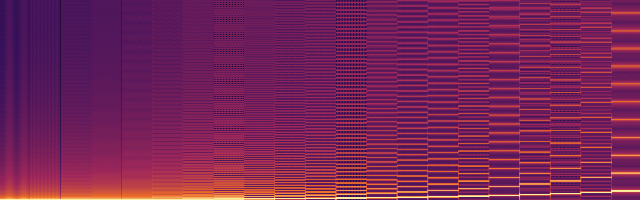
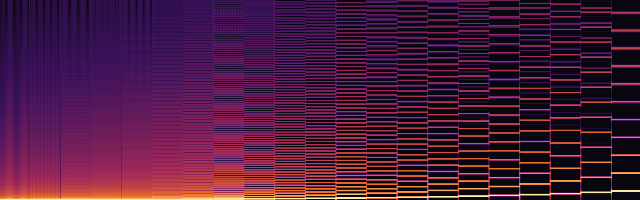
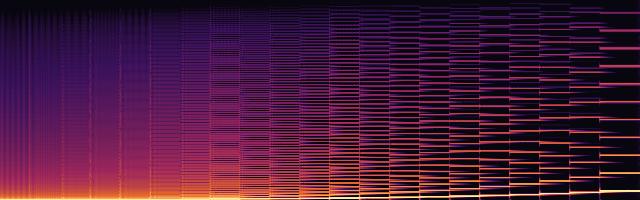
SQR alone, notes C2 to C7 in steps of three semitones, half a second each. Time goes across, and 0 to 24 kHz goes up. Each column shows 70 dB under its loudest tone. The bright lines are the harmonics, and they move up from one note to the next. Aliasing fills the space between them: on high notes, that space is dark with the polyBLEP.
The bottom spectrogram is the unit's recording. On the unit, the lines bend up a little in each note: the pitch rises after the note starts. We did not check why.
Changes without clicks: DCLK
A sudden change of the wave gives a click. DCLK (page 4) is a crossfade for these changes, for each oscillator. A change is sudden when, from one block to the next:
- POS moves by more than 2 frames, or
- the oscillator plays a different table, or
- the gain changes by more than 0.1. At TRIM 0 dB, this is 10 LEV steps. At the default TRIM of −11 dB, it is 36 LEV steps.
A turn of TRIM is never sudden. The trim moves the level by 0.1 dB at most in each block, so the full 15 dB takes about 0.1 s. At a new note, the trim goes to the knob's value at once.
Then the oscillator plays the old settings and the new settings together, at the same phase. The old settings fade out and the new settings fade in, in a straight line over the DCLK time. A smaller change does not start a crossfade.
A sudden change during a crossfade waits until the crossfade ends. Thus, with a long DCLK, a fast LFO on TBL changes table at the speed of the crossfade. A new note does not crossfade. When you replace a table that plays, the DSP builds the new table in a spare region. The old table plays until the new table is ready. Then DCLK crossfades from the old table to the new table.
A change from Prim. to Harm. during a C3 note, at POS 60.
SLW and SYN
SLW means slew. SLW1 and SLW2 (page 4) are a slew on POS, one for each oscillator. Before version 0.1.1, their name was SMT1 and SMT2.
The slew is a one-pole filter that the DSP steps 1,500 times a second. It is not a slew limiter with a fixed rate: POS moves fast at first, and slower as it comes near its target. Its time constant is 2 ms at 1. It doubles every 14 steps, to 1 s at 127. At 0, the slew is off.
How the slew works
For each voice and each oscillator, the DSP keeps one number: the POS that the reader plays, as a 32-bit float. At the start of the sound it is 0. Once a block (1,500 times a second), the DSP moves that number towards the POS that it receives:
s = s + (POS − s) × k
POSis the target: the knob, the p-locks and the LFOs, as the main processor sends them, with MOVE added and the result held inside the table.ksets the speed. It is1 − e−1 / (1,500 τ), with τ the time constant of the SLW value. A table of 128 values, made when the firmware is built, holdsk, so the DSP does not calculate an exponential.- At SLW 0,
kis exactly 1. ThensisPOSin every block, and the sound is the same as with no slew, bit for bit. A new sound starts at 0. - When a new note starts on the voice, the DSP sets
stoPOSat once. - The reader then plays
s, rounded down to its fixed-point position: 16 bits for the fraction of a frame.
This is a one-pole low-pass filter on POS. After one time constant, s has moved 63 % of a
jump. After three time constants, it has moved 95 %.
Changes slower than the cutoff (1 / (2πτ)) pass through. Faster changes lose depth. The slew costs a few dozen instructions for each voice and oscillator in each block. It does not add a cost for each sample.
| SLW | Time constant | k (each block) | Cutoff | 95 % of a jump |
|---|---|---|---|---|
| 0 | Off | 1.000000 | none | at once |
| 1 | 2.0 ms | 0.289178 | 81.49 Hz | 6 ms |
| 15 | 3.9 ms | 0.156897 | 40.74 Hz | 12 ms |
| 29 | 7.8 ms | 0.081794 | 20.37 Hz | 24 ms |
| 43 | 15.6 ms | 0.041769 | 10.19 Hz | 47 ms |
| 57 | 31.2 ms | 0.021107 | 5.09 Hz | 94 ms |
| 71 | 62.5 ms | 0.010610 | 2.55 Hz | 187 ms |
| 85 | 125.0 ms | 0.005319 | 1.27 Hz | 375 ms |
| 99 | 250.0 ms | 0.002663 | 0.64 Hz | 749 ms |
| 113 | 500.0 ms | 0.001332 | 0.32 Hz | 1,498 ms |
| 127 | 1,000.0 ms | 0.000666 | 0.16 Hz | 2,996 ms |
Some SLW values: the time constant, the coefficient that the DSP uses, the cutoff of the filter, and the time to reach 95 % of a jump.
SLW slews the POS that you hear: the knob, p-locks, LFOs and MOVE, added together. Waverider applies the slew after MOVE, just before the reader. The DSP receives POS with the p-locks and the LFOs already added, so it cannot slew one source and not another. Each of the three sources responds as follows:
- A turn of the knob slews to the new value.
- A p-lock on a trig with a note does not slew. A new note starts the slew at its target, so the note plays the locked POS at once. A trigless lock slews.
- An LFO or MOVE on POS slews too. A long SLW reduces the depth of a fast LFO (the table below).
POS from the knob, then from an LFO at 4 Hz, then from a trig with a p-lock, with SLW at 71.
| SLW | Time constant | LFO 0.5 Hz | LFO 2 Hz | LFO 8 Hz |
|---|---|---|---|---|
| 29 | 7.8 ms | 100 % | 100 % | 93 % |
| 43 | 15.6 ms | 100 % | 98 % | 79 % |
| 57 | 31.2 ms | 100 % | 93 % | 54 % |
| 71 | 62.5 ms | 98 % | 79 % | 30 % |
| 85 | 125.0 ms | 93 % | 54 % | 16 % |
How much of an LFO's sweep on POS remains after the slew.
SYN1 and SYN2 (page 4) are different controls. They set MOVE, the oscillator's own modulator, to follow the tempo. With SYN on, RATE shows a note length. SYN does not change the LFOs, which have their own tempo settings, and it does not change p-locks.
The noise
Each voice has its own noise generator, a 32-bit xorshift. Each voice starts from a different seed, so two voices never play the same noise. The four types:
- WHT: the generator's output, white noise.
- PNK: white noise through Paul Kellet's economy pink filter (three one-pole filters and a direct path), about −3 dB an octave.
- BRN: white noise through a leaky integrator, about −6 dB an octave above its corner.
- DIG: the top bit of the generator, ±0.5: a digital, two-level noise.
The spectra of the four types, at COLR 0.
COLR tilts the spectrum. A one-pole low-pass filter at about 1 kHz follows the noise, and COLR subtracts a part of its output from the noise: COLR / 64 of it. A negative COLR adds low frequencies. A positive COLR removes them.
DEC is the decay after each note: an exponential, with a time constant of 5 ms at 0 to 10 s at 126. At Inf, the noise has no decay. A new note starts the decay again.
Page 5: FOLD, the shaper, WARP and FM
Page 5's controls change the sound: FOLD, the shaper's TYPE with AMT, P1 and P2, WARP, FM and FSRC. At 0, each control skips its code, so a sound with page 5 at 0 plays exactly as before. FSRC does nothing while FM is at 0.
FSRC chooses what FM reads. With SUB or NOIS, the sub or the noise plays first, at full level, into FM's buffer, and osc 1 reads it there. At its own place in the mix, it then adds that buffer at its own level, with the same result as before, bit for bit.
FOLD folds the mix of the two oscillators, after the shaper and before the sub and the noise. The fold point is the peak of one oscillator at LEV 100 and TRIM −11 dB. FOLD multiplies the mix by 1 + 7 × FOLD / 127 (up to 8 times at 127). Each part of the wave that goes past the fold point turns back, as a triangle does. A higher LEV or TRIM sends more of the wave past the fold point, so it gives more folds.
The output for each input sample. At FOLD 0 the output is the input.
Two cycles of osc 1, with osc 2 off.
TYPE selects the shaper and AMT sets how much of it you hear. With b the mix of the two oscillators, the shaper's output is b + AMT / 127 × (s − b):
- Ring: s = osc 1 × osc 2 / P, with P the fold point. The output has the sum and the difference of the two oscillators' frequencies, and not the oscillators themselves.
- AM: s = osc 1 × (1 + osc 2 / P) / 2. Osc 2 changes the level of osc 1.
With osc 2 off (LEV2 at 0), Ring makes the mix quieter by AMT, and AM halves it at AMT 127. AMT uses the record of WaveTone's master tune, so a new sound starts with AMT at 64. TYPE at Off ignores AMT.
C3 on osc 1 and G3 on osc 2 (both Prim. at POS 64, TUN2 +7), LEV2 100.
WARP bends the phase of each oscillator before it reads its wave. Two straight lines replace the phase: the first half of the wave plays in the first part of the cycle, and the second half in the rest. At WARP 127, the first half of the wave plays in 1/20 of the cycle. The slope of the first line is 1 + 9 × WARP / 127. The two lines meet where the wave's middle is read. POS and the table do not change. To keep the steep part clear of aliasing, the reader selects its mip level for the slope of the first line.
Where the oscillator reads its wave, for each point of its cycle.
Two cycles of osc 1, with osc 2 off.
FM adds the output of osc 2 to the phase of osc 1, sample by sample (phase modulation, the method of most FM synths). At FM 127, the peak of osc 2 moves osc 1's phase by one whole cycle. Osc 2's own wave also sets the depth, but LEV2 does not: LEV2 sets only how loud osc 2 is in the mix. Under FM, osc 2 plays first in each block, so osc 1 can read its samples. The reader selects osc 1's mip level for its fastest phase: its increment plus 2π × FM / 127 × osc 2's.
Osc 1 alone, C3 on both oscillators (Prim. at POS 64), LEV2 100.
The cost. Measured in digikit's SHARC runner, in instructions per voice and block. A block on the DSP is about 666,667 cycles.
| Control | Per voice and block | 16 voices, share of a block |
|---|---|---|
| FOLD | 369 | 0.9 % |
| Ring | 363 | 0.9 % |
| AM | 431 | 1.0 % |
| AM and FOLD together | 800 | 1.9 % |
| WARP | 710 | 1.7 % |
| FM | 482 | 1.2 % |
| WARP and FM together | 1,138 | 2.7 % |
| AM, FOLD, WARP and FM together | 1,898 | 4.6 % |
The high range: when a frame loses every partial
The mip levels remove every harmonic that would pass 28 kHz (see Aliasing: the mip levels). Most frames keep their fundamental at every note, so a high note only sounds duller. A frame that has all its energy in high partials can lose all of it. The oscillator then plays nothing. It stops in one step, with no fade.
Three settings bring a frame to this point:
- The note. TUNE and DETN add to it. DETN can put osc 2 up to 63 semitones above osc 1.
- The frame. Each frame of Harm. is one partial: frame 1 is the fundamental, and frame 16 is the 16th partial. POS 48 plays the 7th partial alone. A pool table whose frames hold only high harmonics can do the same.
- WARP and FM. The reader selects its level for the steepest part of the bent phase. That part plays 1 + 9 × WARP / 127 times faster than the note: 3.48 times at WARP 35, about 21.6 semitones higher. FM selects osc 1's level for its fastest phase in the same way.
The highest harmonic that the reader keeps, for each note, in a 512-point frame such as Harm.'s. The line at 7 is Harm. at POS 48, the 7th partial alone. Where a curve is below that line, the frame plays nothing.
A case to reproduce
A tester's sound had osc 2 at DETN +57 with TUNE −6, on Harm. at POS 48, with WARP 35. Osc 2 made no sound. These steps give the same result with fewer settings:
- On a Waverider track, set page 1's LEV to 0 and TUNE to 0.
- On page 2, set TBL to Harm., POS to 48 and LEV to 100. The scope shows seven cycles.
- Play C4. Osc 2 plays its 7th partial, at 1,831 Hz.
- Turn DETN up. At 47 osc 2 still plays. At 48 it is silent.
- Set DETN to 26. Osc 2 plays again.
- On page 5, set WARP to 35. Osc 2 is silent. At WARP 0 it plays again.
Osc 2 alone, C4, TUNE 0, Harm. at POS 48. The level stays the same until the reader removes the 7th partial, then drops to nothing. Right of the line, the partial is above 24 kHz and plays folded back, at 20 to 24 kHz.
| DETN | Osc 2's note | Its 7th partial | WARP 0: harmonics kept | WARP 0: osc 2 | WARP 35: harmonics kept | WARP 35: osc 2 |
|---|---|---|---|---|---|---|
| 0 | C4 | 1,831 Hz | 63 | -14.0 dB | 15 | -14.0 dB |
| 12 | C5 | 3,663 Hz | 31 | -14.0 dB | 15 | -14.0 dB |
| 25 | C#6 | 7,761 Hz | 15 | -14.0 dB | 7 | -14.0 dB |
| 26 | D6 | 8,223 Hz | 15 | -14.0 dB | 3 | silent |
| 45 | A7 | 24,640 Hz | 7 | -14.1 dB | 1 | silent |
| 47 | B7 | 27,657 Hz | 7 | -14.0 dB | 1 | silent |
| 48 | C8 | 29,302 Hz | 3 | silent | 1 | silent |
| 57 | A8 | 49,280 Hz | 3 | silent | 1 | silent |
To keep osc 2 in the high range, lower DETN or WARP, or move POS to a frame with a lower partial.
MIDI CC and NRPN
Every knob on the five pages takes a CC and an NRPN on its track's channel. Pages 1 to 4 use the numbers the same knob has on the other machines. Page 5 has numbers of its own. With MIDI out on, a knob sends the number in this table.
| Page | Knob | Label | Name | CC | NRPN |
|---|---|---|---|---|---|
| 1 | A | TUNE | Osc1 Tune | 40 | 1:73 |
| 1 | B | LEV | Osc1 Level | 41 | 1:74 |
| 1 | C | POS | Osc1 Position | 42 | 1:75 |
| 1 | D | TBL | Osc1 Table | 43 | 1:76 |
| 1 | E | RATE | Osc1 M.Rate | 44 | 1:77 |
| 1 | F | MLEV | Osc1 M.Level | 45 | 1:78 |
| 1 | G | MPOS | Osc1 M.Pos | 46 | 1:79 |
| 1 | H | MOVE | Osc1 M.Shape | 47 | 1:80 |
| 2 | A | DETN | Osc2 Detune | 48 | 1:81 |
| 2 | B | LEV | Osc2 Level | 49 | 1:82 |
| 2 | C | POS | Osc2 Position | 50 | 1:83 |
| 2 | D | TBL | Osc2 Table | 51 | 1:84 |
| 2 | E | RATE | Osc2 M.Rate | 52 | 1:85 |
| 2 | F | MLEV | Osc2 M.Level | 53 | 1:86 |
| 2 | G | MPOS | Osc2 M.Pos | 54 | 1:87 |
| 2 | H | MOVE | Osc2 M.Shape | 55 | 1:88 |
| 3 | A | SUB | Sub Level | 56 | 1:89 |
| 3 | B | OCT | Sub Octave | 57 | 1:90 |
| 3 | C | WAVE | Sub Wave | 58 | 1:91 |
| 3 | D | SRC | Sub Source | 59 | 1:92 |
| 3 | E | NOIS | Noise Level | 60 | 1:93 |
| 3 | F | TYPE | Noise Type | 61 | 1:94 |
| 3 | G | COLR | Noise Colour | 62 | 1:95 |
| 3 | H | DEC | Noise Decay | 63 | 1:96 |
| 4 | A | PRST | Osc Phase Reset | 70 | 1:97 |
| 4 | B | TRIG | Move Retrig | 71 | 1:98 |
| 4 | C | DCLK | Declick | 72 | 1:99 |
| 4 | D | TRIM | Level Trim | 73 | 1:100 |
| 4 | E | SYN1 | Osc1 M.Sync | 74 | 1:101 |
| 4 | F | SYN2 | Osc2 M.Sync | 75 | 1:102 |
| 4 | G | SLW1 | Osc1 POS Slew | 76 | 1:103 |
| 4 | H | SLW2 | Osc2 POS Slew | 77 | 1:104 |
| 5 | A | FOLD | Wave Fold | 12 | 1:112 |
| 5 | B | WARP | Phase Warp | 15 | 1:113 |
| 5 | C | FM | FM Depth | 35 | 1:114 |
| 5 | D | FSRC | FM Source | 36 | 1:115 |
| 5 | E | TYPE | Shaper Type | 37 | 1:116 |
| 5 | F | AMT | Shaper Amount | 83 | 1:117 |
| 5 | G | P1 | Shaper P1 | 93 | 1:118 |
| 5 | H | P2 | Shaper P2 | 119 | 1:119 |
A CC sets the value from 0 to 127. An NRPN takes a 14-bit value, MSB first. A knob with a short list, such as TYPE, takes the last entry for any value past the end of the list.